
A buying guide
A western boot looks like a single object, but it is really a short stack of choices: the shape of the toe, what sits under your heel, whether the leather is real, and how much of that matters when the foot inside is still growing. Smoky Mountain builds the same boot at both scales, which is rarer than it sounds.
Start at the front of the boot, because it is the one decision you cannot undo by wearing it in. A square toe gives the foot a flat, wide box to sit in, and it has become the default across most of the western world. It is roomier across the ball of the foot and it reads as modern, which is either the point or the problem depending on your taste.
A round toe is the older shape, narrowing gently rather than being cut off. It sits quieter under a bootcut jean, and it is generally what you want if the boot is going to be worn for a whole day rather than an evening. Smoky Mountain puts it on the children's Denver, which is not an accident: a round toe forgives a foot that has not finished deciding what shape it is.
The men's boots here mostly carry a western toe — the traditional tapered shape with a slight point — paired with a western heel. If you have only ever worn a square toe, expect the first hour to feel narrower than you are used to. That is the shape doing its job, not the boot being too small.
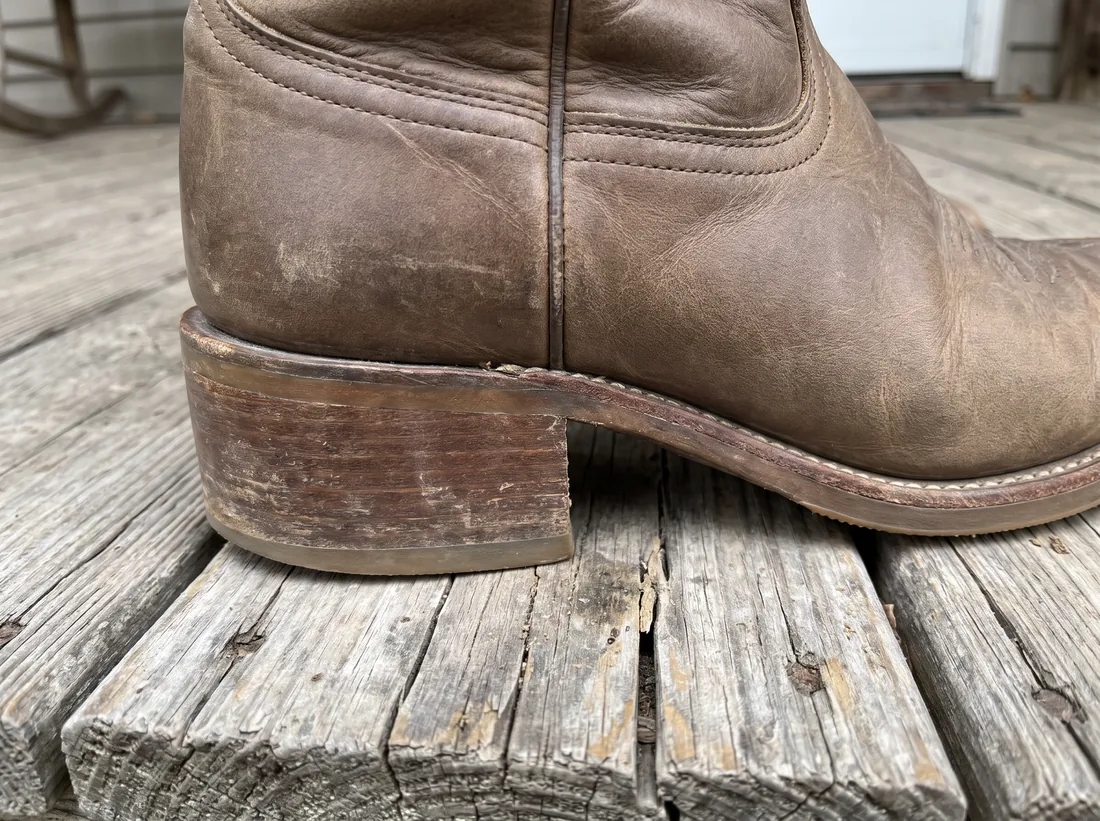
Turn the boot over. A stacked leather block heel is built from layers of leather pressed together, which is why you can read the strata on the side of it, and why it wears down gradually rather than all at once. A cobbler can replace the top layer without touching the rest, so a boot with a stacked heel is worth repairing in a way that a moulded one usually is not.
The block shape is squarer and lower than a riding heel. It gives you a flat surface to stand on all day, which is what you want if the boot is for work rather than for sitting on a horse. Several boots in this range pair it with a rubber outsole, and that combination is the practical one: leather where the boot gets rebuilt, rubber where it meets a wet yard.
Inside, between the heel and the ball of the foot, sits a steel shank. It is a thin strip of metal that stops the boot folding in the middle, and it is the single biggest reason a western boot feels rigid underfoot compared with a trainer. It also means the sole holds its shape for years while the upper softens around your foot — the two halves age at completely different rates.
Genuine leather breathes, which in a boot means the inside stays drier across a long day. More usefully, it stretches: it gives where your foot pushes and stays put where it does not, so after a few weeks the boot fits one person properly rather than fitting everyone approximately. That is the whole argument for leather, and it is a good one.
Faux leather does neither of those things. It also does not scuff pale, does not need conditioning, wipes clean with a cloth, and costs less. Smoky Mountain uses it on some of the children's boots, and for a boot that will be outgrown inside a year that is the sensible choice rather than the cheap one.
Watch for the mixed construction, which is common here and easy to misread: a leather upper with a man-made lining. The part that shapes to your foot is leather; the part against your sock is not. It is a fair compromise, and it is why a boot at this price can have a real leather upper at all.
Children's western boots solve a problem most children's shoes do not: there are no laces and no buckles, so a four-year-old can put them on unaided. That is what the pull-on tabs at the top of the shaft are for, and it is most of the reason these boots get worn rather than argued about.
Buy them to fit now, not to grow into. An all-leather children's boot will stretch over a few months to the shape of the foot inside it, which is useful — but a boot bought two sizes large does not stretch, it slips at the heel, and a slipping heel is how a child learns to hate a pair of boots. The shaft should be loose enough to pull on without a fight; the heel should stay put when they walk.
The Denver is the one worth knowing about, because it exists in both a men's and a children's version. That is unusual — most brands design a children's boot as a miniature of nothing in particular. Here you can put a child in the same boot their father is wearing, in a round toe, in real leather, and it will stretch to their foot the same way his did.
10 boots across the range. Each one opens its listing on Amazon, where the sizing and the current price live.